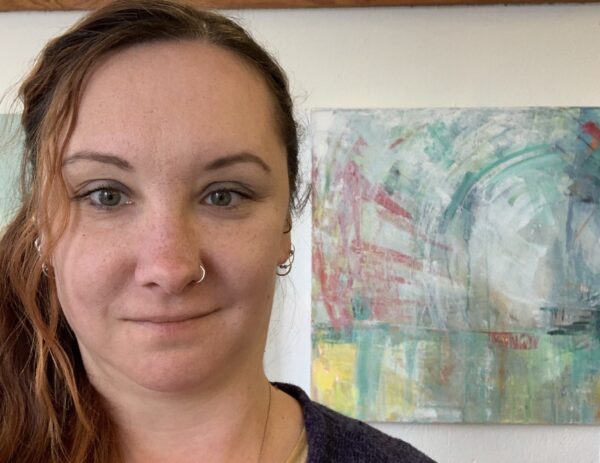
Beki Borman was born and raised in the Milwaukee area of Wisconsin. She attended the Milwaukee Institute of Art & Design where she received her BFA in painting in 2004. Since graduating, Beki has exhibited both locally and nationally. Beki uses a range of mediums and often combines both painting and drawing techniques. . Her images are based on nature and use color and pattern to create expressive interpretations of organic forms. Some of Beki’s influences include Gerhard Richter, Vincent Van Gogh, and Frantisek Kupka. She currently works out of her studio at the Bay View Hide House.
Abstract Landscapes Expressions
Beki Borman
I have spent much of my life pursuing science in my art. I have tried to weave an expression of science into both my imagery and thought process. This pursuit has been as much about expressing science as it has been about rejecting the self. The truth that I have found, in trying to paint without emotions, feeling, or humanity, is that it is still there and the works are still expressions of me. In my abstract landscape series, I am embracing the inevitability of the human experience and celebrating the pure joy of color, shape, and design. I feel the science is still there, underneath it all, but ultimately these are spiritual experiences. I have for a long time rejected spirituality, and I still do in many logical ways. However, I have come to realize that humanity cannot exist without some of the fundamental aspects of spirituality, like beauty, awe, and hope. These works let down the barriers and show my true expression of experience.
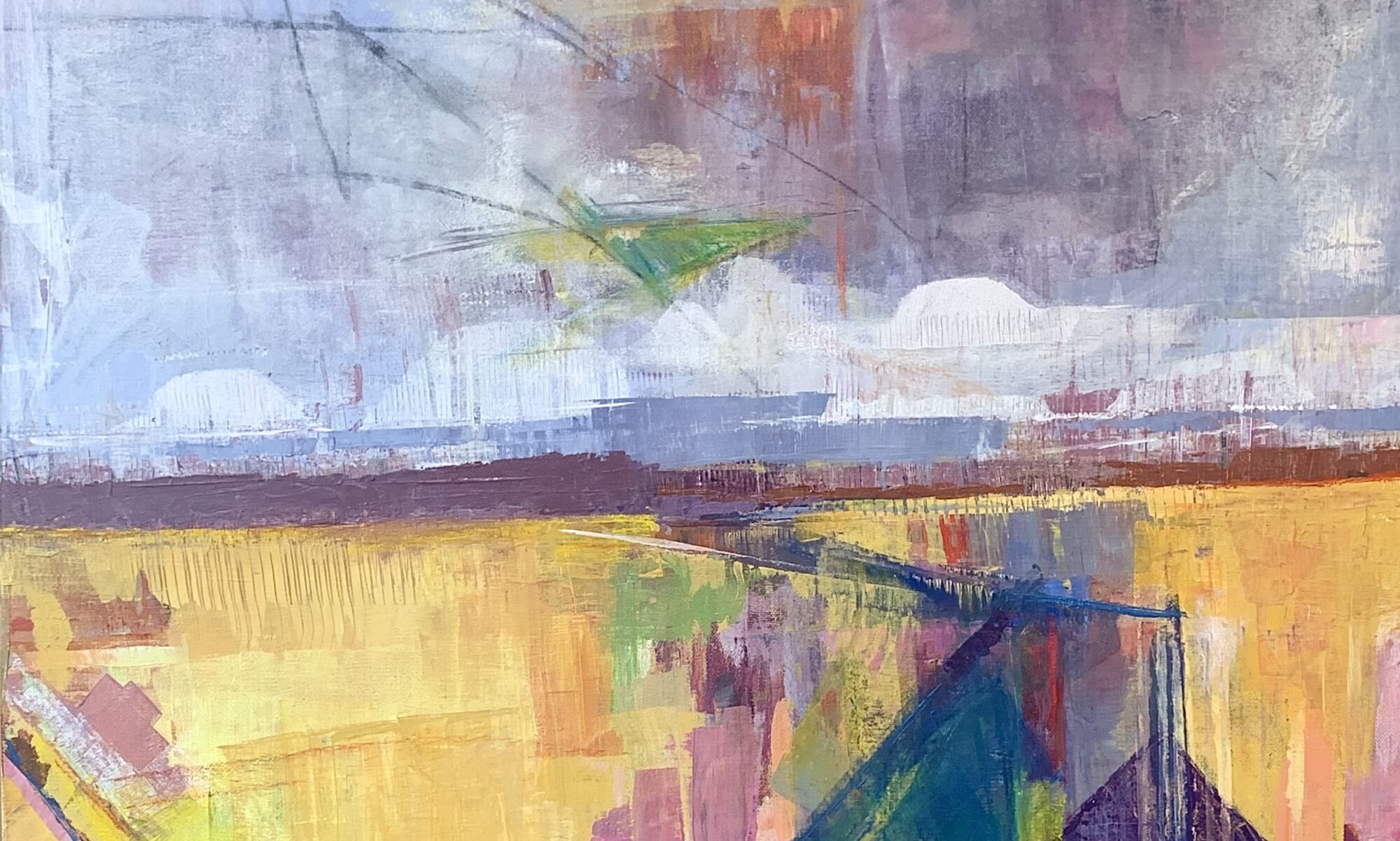
Using thin layers of acrylic like washes I create very natural, movable forms. I draw into them often in reaction to the forms created. The decisions are based partly on expression of a form, and partly on aesthetic experience. I consider these to be paintings of landscapes, and this fundamental theme affects the design of the image. The images sometimes start with a reference, and sometimes merely references themselves. They are intuitive and organic and focus on pure aesthetic. Aesthetics is one of the most basic understandings of beauty. While these works may or may not be beautiful, I want the experience to be a simple delight in colors and movements.
The process in making these is slightly detached, in that they are usually placed on the floor, and I move around them, dripping and pushing color much like Pollock. However, I integrate myself in the work much more than Pollock would. I let things happen, but I also edit, tweak, and revisit. I would like to think that I am in many ways simply finding the image, like a crusader traveling the world, seeking new lands. Clearly I make them, but if I make them too much, they are no longer real.
The pastel drawings are a bit different, usually much more controlled. They often tend to be more representational due to the nature of the medium. I consider these drawings important works, but also a necessary put of the process.
Bio & Statement
Beki Borman was born and raised in the Milwaukee area of Wisconsin. She attended the Milwaukee Institute of Art & Design where she received her BFA in painting in 2004. Since graduating, Beki has exhibited both locally and nationally. Beki uses a range of mediums and often combines both painting and drawing techniques. . Her images are based on nature and use color and pattern to create expressive interpretations of organic forms. Some of Beki’s influences include Gerhard Richter, Vincent Van Gogh, and Frantisek Kupka. She currently works out of her studio at the Bay View Hide House.
Abstract Landscapes Expressions
Beki Borman
I have spent much of my life pursuing science in my art. I have tried to weave an expression of science into both my imagery and thought process. This pursuit has been as much about expressing science as it has been about rejecting the self. The truth that I have found, in trying to paint without emotions, feeling, or humanity, is that it is still there and the works are still expressions of me. In my abstract landscape series, I am embracing the inevitability of the human experience and celebrating the pure joy of color, shape, and design. I feel the science is still there, underneath it all, but ultimately these are spiritual experiences. I have for a long time rejected spirituality, and I still do in many logical ways. However, I have come to realize that humanity cannot exist without some of the fundamental aspects of spirituality, like beauty, awe, and hope. These works let down the barriers and show my true expression of experience.
Using thin layers of acrylic like washes I create very natural, movable forms. I draw into them often in reaction to the forms created. The decisions are based partly on expression of a form, and partly on aesthetic experience. I consider these to be paintings of landscapes, and this fundamental theme affects the design of the image. The images sometimes start with a reference, and sometimes merely references themselves. They are intuitive and organic and focus on pure aesthetic. Aesthetics is one of the most basic understandings of beauty. While these works may or may not be beautiful, I want the experience to be a simple delight in colors and movements.
The process in making these is slightly detached, in that they are usually placed on the floor, and I move around them, dripping and pushing color much like Pollock. However, I integrate myself in the work much more than Pollock would. I let things happen, but I also edit, tweak, and revisit. I would like to think that I am in many ways simply finding the image, like a crusader traveling the world, seeking new lands. Clearly I make them, but if I make them too much, they are no longer real.
The pastel drawings are a bit different, usually much more controlled. They often tend to be more representational due to the nature of the medium. I consider these drawings important works, but also a necessary put of the process.